
Six Ways to Make Local Government Contact Centers More Productive
Every day, local government leaders have to find ways to provide more services with fewer resources while keeping citizens informed, supported, and happy. Communities are expecting more, and budgets are tight, so there isn’t much room for inefficiency.
That’s why so many councils are turning to Conversational AI for Local Government. It’s not just about automation; it’s a better way to give people the information and services they need whenever and however they want.
For contact center managers and IT teams, Conversational AI for Local Government is a real chance to speed up problem-solving, make services easier to get, and shift resources to handle more complicated, high-value enquiries.
Here are six strong ways that Conversational AI for Local Government is already changing how people interact with UK local government.
1. Route it! Faster, send citizens to the right team.
People have to go through menus, wait a long time, and be transferred over and over again when they use traditional call-routing systems. That changes with Conversational AI for Local Government.
Instead of pushing buttons, people just say what they need, like “report a pothole,” “book a bulky waste collection,” or “make a payment.” The technology knows what the request is and either sends it to the right team right away or gives the answer instantly.
This cuts down on wait times and calls that go to the wrong place by a huge amount, and it makes sure that agents only deal with questions that need human judgement and empathy. Using AI in contact centers has cut customer wait times by as much as 55%, changing the way service is delivered.
2. Tell someone! Get problems under control before they get worse.
If you don’t report small problems right away, they can quickly turn into expensive repairs or safety risks.
Conversational AI for Local Government makes it easy for people to report problems, like trash on the ground, broken playground equipment, or flooded roads. The system gathers the information and sends it to the right department, whether it’s by phone or web chat. It also automatically raises tickets.
This helps keep communities safe and well-kept and makes sure that responses come faster.
3. Ask it! Give quick answers to common questions.
Every day, hundreds of routine questions are handled by every council contact center:
-
“When is the trash pickup this week?”
-
“How do I get a parking permit?”
-
“Where do I go to report a change in my situation?”
Using libraries of preconfigured responses, Conversational AI for Local Government answers these questions right away over both voice and digital channels. Councils are always improving their self-service options thanks to ongoing analytics.
AI already handles more than half of tax-related calls in one London borough, showing how much easier it is for contact center teams that are already stretched thin.
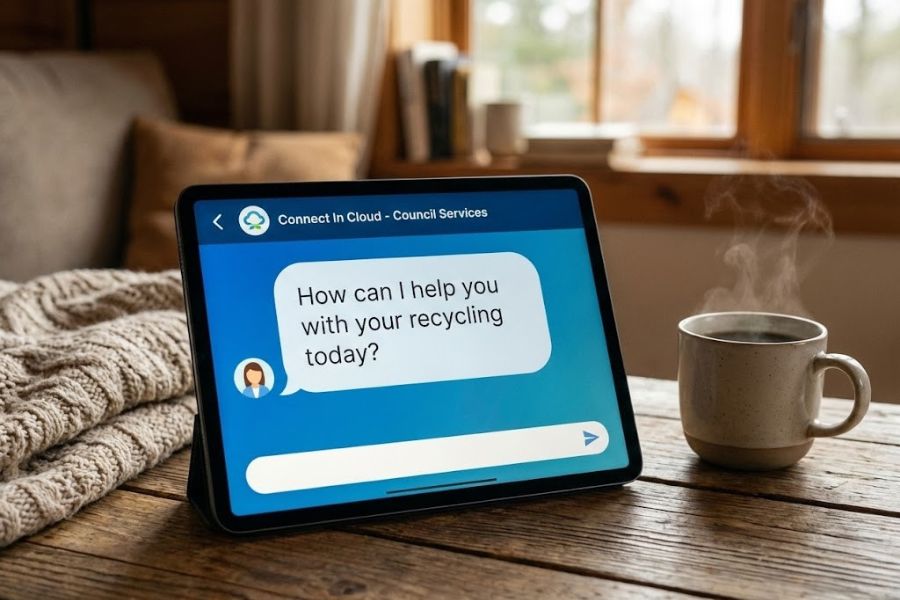
4. Recycle it! Get rid of confusion and promote sustainability.
People often want to recycle more, but they don’t know what can be recycled and how to do it. When people are confused, it leads to contamination, missed targets, and higher costs for councils.
implementing Conversational AI for Local Government clears up any confusion by giving you quick and correct information about how to get rid of certain things, when your trash will be picked up, or where to drop things off in your area. This is good for the environment and helps councils save money, recycle more, send less trash to landfills, and make real progress toward the government’s goal of 65% recycling by 2035.
5. Make a reservation! Make it easier to schedule appointments.
Making appointments can be more difficult than it should be for things like housing inspections, social care, and talking about educational needs. People have to call during business hours, wait in queue and talk to staff back and forth.
Conversational AI for Local Government makes things easier and more accessible. People can make, check, or change appointments at any time of day or night by phone or online. The system automatically asks the right questions, checks to see if there is space, and confirms reservations. The result is that scheduling is easier and fewer appointments are missed.
6. Vote on it! Help make elections fair and easy to get to.
Local councils have a lot of work to do when it comes to running elections. People need help with registering to vote and choosing candidates, as well as correct information about where, when, and how to vote.
Routing regular questions through Conversational AI for Local Government gives people a reliable, always-on source of information. People can get the information they need right away, through the channel they choose. Fewer people are calling in, and 24/7 access makes election days go more smoothly and helps get more people to vote.
Are you ready to move on?
Conversational AI for Local Government is no longer something we hope for in the future; it’s here now, and councils all over the UK are already seeing the benefits.
Get our guide, “6 Ways Conversational AI for Local Government Can Support You,” to see case studies, real-life examples, and tips on how your council can start its own AI journey. Local government doesn’t just keep up with change; it leads it when technology and people work together.